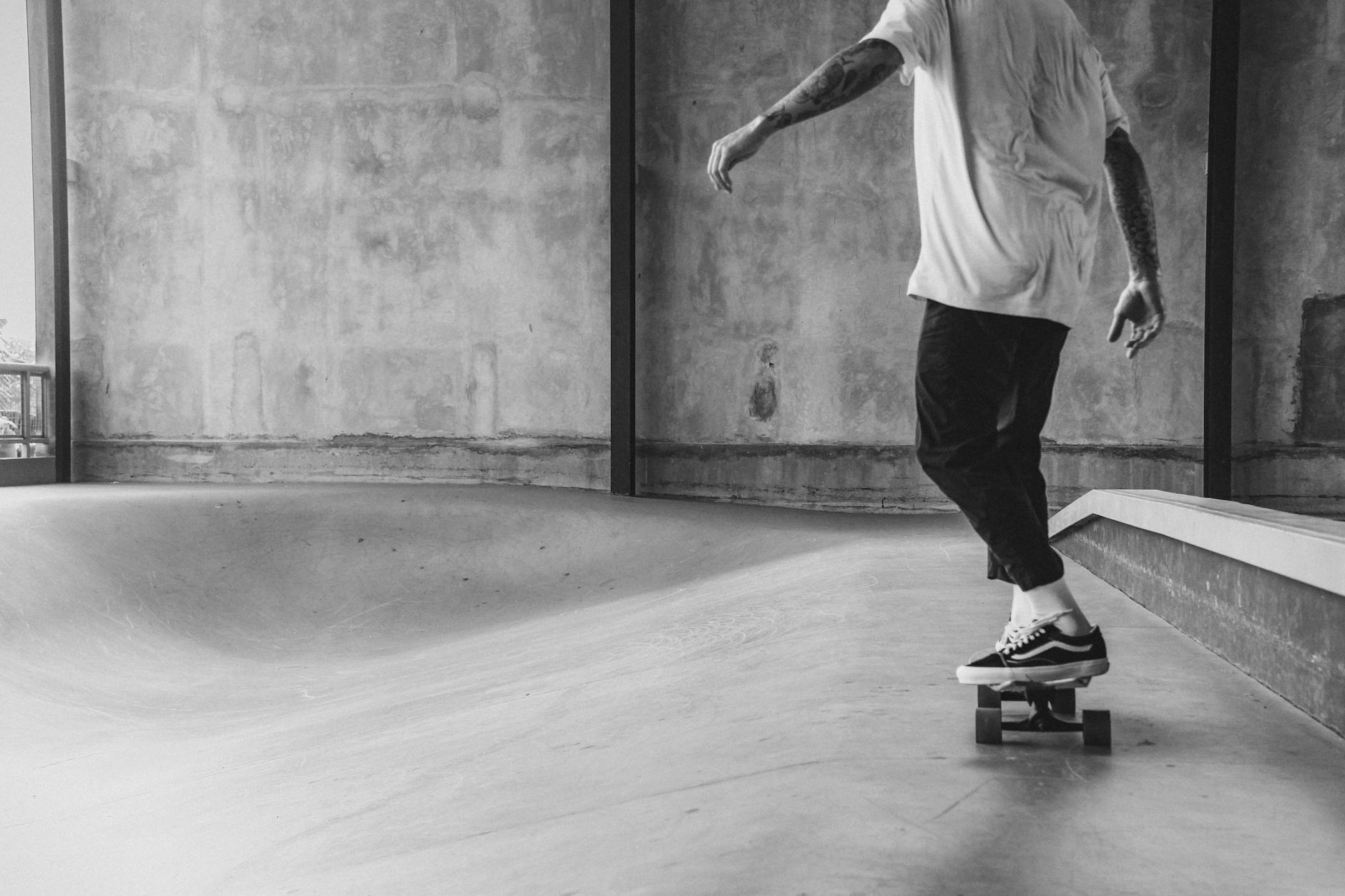
Progression in Skateboarding: Beginner to Intermediate
So you want to learn to skate. Maybe you watched someone cruise through a park and thought it looked effortless, or perhaps you grew up seeing videos of skaters at Southbank and always fancied giving it a go yourself. Whatever brought you here, you’re in the right place. Skateboarding is one of those activities that looks impossibly difficult from the outside and then, gradually, starts to click in the most satisfying way imaginable. This guide is here to walk you through that journey — from your very first wobbly push to landing your first proper tricks — with honest, practical advice rooted in the UK skate scene.
Getting the Right Setup
Before you even think about standing on a board, you need the right kit. This is where a lot of beginners go wrong, and it can make a real difference to how quickly you progress.
A complete skateboard from a reputable skate shop is always the better choice over a cheap supermarket board. Those low-cost boards — often labelled as “toy boards” within the skating community — use inferior bearings, brittle decks, and trucks that don’t turn properly. They make learning significantly harder and can actually be unsafe. In the UK, shops like Slam City Skates in London, Ideal in Brighton, Native Skate Store in Exeter, or Route One (which also has a solid online store) will set you up with a proper complete board for somewhere between £70 and £120. That’s genuinely worth every penny.
For a beginner, a deck width of around 8 to 8.25 inches is a good starting point for most adults. Wider boards (8.5 inches and above) are more stable, which some beginners prefer, while narrower boards feel more responsive for tricks. Your trucks should match your deck width, and most complete setups from a skate shop will get this right automatically.
Protective gear matters too, especially on UK concrete that seems to have been specifically engineered to graze knees. A helmet, knee pads, and wrist guards are not embarrassing — they’re sensible. Triple Eight and Pro-Tec make excellent gear, and you’ll find both brands stocked in most UK skate shops. Wrist injuries are by far the most common beginner injury, because the natural instinct is to put your hands out when you fall. Wrist guards dramatically reduce that risk.
Finding Somewhere to Skate
The UK has a surprisingly rich selection of places to skate, even if the weather doesn’t always cooperate. Skate parks are your best starting point. They provide a safe, designated space, and you’ll often find other skaters who are happy to offer tips or just share the space without judgement.
Most towns and cities now have at least one public skate park, many of which are free to use. London has iconic spots like Southbank (though it’s worth knowing that this is a historic street spot with its own unwritten etiquette), Bay Sixty6 in Ladbroke Grove, and House of Vans in Waterloo for covered indoor sessions. Manchester’s Projekts is a well-respected indoor facility. Sheffield has the fantastic FlyUp 417, and Bristol — with its deep skate culture — has multiple parks and street spots throughout the city.
Outdoor parks do come with the British weather problem. Indoor parks charge a session fee, typically between £5 and £10, but they offer year-round skating regardless of whether it’s hammering down outside. Many also run beginner sessions or lessons, which can be brilliant for your first few times on a board.
As a complete beginner, smooth, flat tarmac or a quiet car park on a dry day is often ideal before you attempt a skate park. A smooth surface lets you get used to the feel of the board without obstacles getting in the way.
Your First Sessions: Getting Comfortable on the Board
The very first thing to figure out is your stance. Most people skate either regular (left foot forward) or goofy (right foot forward). A quick way to work it out: stand with feet together and have someone gently push you from behind. Whichever foot you instinctively step forward with is likely your lead foot.
Once you know your stance, here’s a sensible order of progression for your first few sessions:
- Stand and balance. Place the board on grass to stop it rolling, stand on it, and just get used to the feeling of being on top of it. Move your weight around, feel how it responds. Spend five minutes here before you even try to move.
- Push and ride. On a smooth, flat surface, place your front foot over the front bolts (the screws holding the truck to the deck) and use your back foot to push. Once you’ve pushed, bring your back foot up onto the tail end of the board and ride it out. This is the single most important thing to get comfortable with.
- Learn to stop. Drag your back foot flat against the ground. It wears your shoes down, yes, but it works and it’s safe. Tail scraping (pressing the tail down to the ground) is another method, though it’s harder to control at first.
- Practise turning. Lean your weight into your heels (heel-side turn) or toes (toe-side turn) to steer. Your trucks will tilt the board and change your direction. This takes a bit of getting used to, but it comes naturally after a couple of sessions.
- Kick turns. A kick turn is lifting the front wheels slightly and pivoting on your back wheels to change direction. Start with small pivots and work up to larger ones. This is your first taste of actual board control.
- Learn to fall properly. This sounds odd, but knowing how to fall reduces injuries. Aim to roll rather than catching yourself with stiff arms. Bend your knees, stay loose, and try to spread the impact across your body. It’s a skill that takes practice, but it genuinely helps.
Give yourself at least three or four sessions just on these fundamentals before you rush into anything more advanced. Many beginners get frustrated trying tricks too early, before they’re genuinely comfortable just rolling around. The skaters who progress fastest are almost always the ones who put time into basics first.
Moving into the Skate Park
Once you’re comfortable riding flat ground, the skate park opens up a whole new world. It can feel intimidating at first — there are people flying around, grinding rails, and doing things that look physically impossible. But every single one of those skaters was once standing where you are now.
Start on the mellow sections. Most parks have a flat area or a gentle bank. Get comfortable riding up a small ramp and rolling back down. Pumping — the action of pushing down through your legs as you go into a transition (the curved part of a ramp) and extending as you come out — generates speed without pushing and is an essential skill for any ramp skating.
Skate park etiquette is worth knowing early on. Don’t snake other skaters (cutting in front of someone mid-run), wait your turn on the obstacles, and shout a heads-up if you’re rolling into someone’s line. The skate park has an informal code, and most skaters are welcoming if you’re respectful of it. If you’re unsure, just watch how others are using the space for a few minutes before joining in.
Your First Tricks: The Ollie and Beyond
The ollie is the foundational trick of street skateboarding. Nearly every other flat-ground trick is built on top of it. An ollie is essentially jumping with the board — the back foot kicks the tail down, the front foot slides up the board to level it out, and both feet land together. On paper, it sounds straightforward. In practice, it takes most beginners weeks of consistent practice to land it cleanly.
Here’s a realistic approach to learning the ollie:
- Start stationary. Place the board on grass, or in front of a wall where you can hold on for balance. Get the motion of the pop (back foot kicking the tail) and the slide of the front foot without worrying about height.
- Practise your foot placement. Back foot on the very tail of the board, front foot just behind the front bolts at a slight angle.
- Film yourself. Even on your phone. It’s remarkably hard to know what your body is doing mid-trick without seeing it, and the footage will show you immediately if your knees are bending enough, if your arms are helping your balance, or if your front foot is sliding properly.
- Once it’s clicking stationary, try it rolling slowly. Rolling ollies feel completely different from stationary ones, but they’re actually easier once you commit to them.
- Be patient. Seriously. Most people take between two weeks and two months to land a clean rolling ollie, depending on how often they skate. That’s completely normal.
After the ollie, the next natural steps tend to be the shuvit (spinning the board 180 degrees under your feet without your body rotating) and the kickflip (the board flipping along its length). Many skaters also spend time learning to manual (balancing on two wheels) and to ride fakie (backwards, in the direction your heels are pointing). None of these happen overnight, and that’s entirely the point — there’s always something new to work towards.