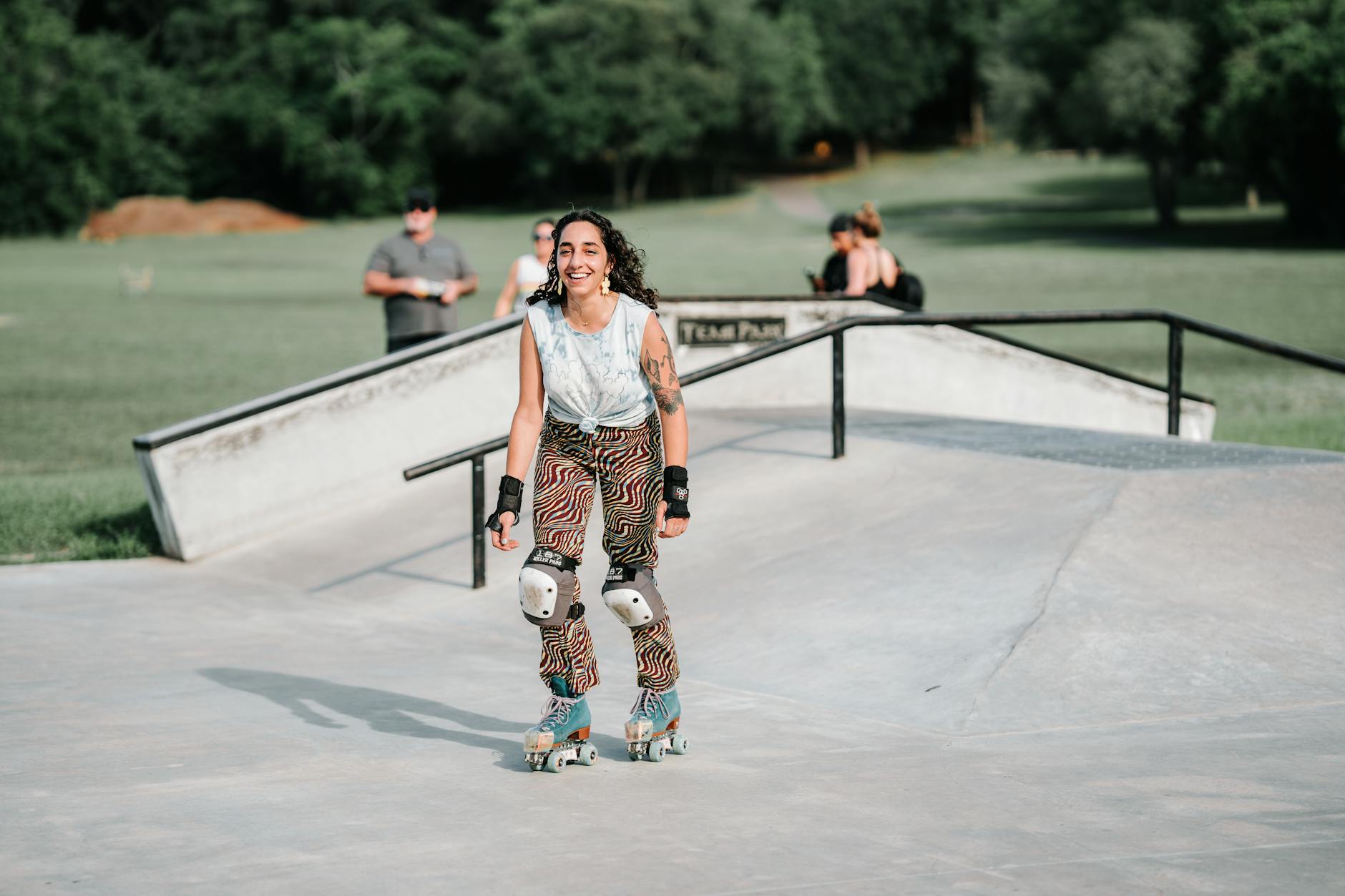
How to Drop In at a Skate Park
There are very few moments in skating that feel quite like your first successful drop in. You’re standing at the top of a ramp, board balanced on the coping, heart hammering away, and then — you commit. The feeling when it works is genuinely brilliant. The feeling when it doesn’t is a scraped knee and a bruised ego, which is also fine, because that’s part of it too.
Dropping in is one of those foundational skills that unlocks the rest of the skate park for you. Once you’ve got it dialled, transitions stop being intimidating and start being the most fun thing in the building. Whether you’re on a skateboard or inline skates, the principle is similar enough that this guide covers both — with notes where the technique differs in meaningful ways.
This isn’t going to be a watered-down “just believe in yourself” kind of article. You deserve actual, honest advice about what dropping in involves, how to learn it safely, and why most beginners struggle with it in the first place.
What Actually Is a Drop In?
For absolute beginners: a drop in is the act of starting at the top of a ramp or quarter pipe, placing your board on the coping (the metal or concrete lip at the top edge), and using your body weight to roll down into the transition rather than approaching from the flat bottom. It’s how you get momentum quickly, and it’s the standard way to enter any ramp properly.
The ramps you’ll find at most UK skate parks — whether it’s a local council-built outdoor spot like the one in Southsea, a well-established indoor park like House of Vans in London, or your local leisure centre’s skate facility — will have quarter pipes and half pipes of various sizes. The small stuff might only be a metre or so tall. Proper half pipes can be three metres or more. Start small. Seriously, start embarrassingly small if you have to. No one who actually skates is going to judge you for learning properly.
Why Is It So Hard to Learn?
Here’s the honest truth: dropping in is almost entirely a mental challenge. The physical mechanics, once you understand them, are not complicated. Your brain, however, is convinced you’re about to die. That feeling of leaning forward over a steep ramp runs directly against every survival instinct you have, and your brain is going to shout at you to lean back. Leaning back, unfortunately, is exactly how you fall.
This is the central problem. Leaning back — away from the ramp — sends your wheels out from under you, your board shoots forward, and you land hard on your backside or your back. It hurts. Committing forward, on the other hand, puts your weight over the front of the board, keeps your wheels in contact with the ramp surface, and lets you roll smoothly down into the transition.
Understanding this intellectually is easy. Convincing your body to do it when you’re standing at the top of a ramp for the first time is another matter entirely. The gap between knowing and doing is where all the actual learning happens, and it’s perfectly normal for it to take several sessions before it clicks.
What You’ll Need Before You Start
Protective gear is not optional for learning this skill, and anyone who tells you otherwise is not your friend. A helmet is the absolute minimum — and if you’re skating at an indoor park in the UK, most reputable venues (including Adrenaline Alley in Corby, Planet Roller Skate in Sheffield, and similar spots) will require one by their own rules. Beyond that, knee pads and wrist guards make a real difference when you’re repeatedly falling whilst learning something new.
For buying gear in the UK, you’ve got decent options. Decathlon stocks affordable, solid beginner-level protection — their own-brand knee pads are genuinely good value. For more specialist kit, shops like Route One (which has physical stores and a strong online presence) and Slam City Skates in London stock higher-end protection from brands like Triple Eight, Pro-Tec, and 187 Killer Pads. If you’re inline skating, Skatehut is worth a look for both skates and protection.
Your board or skates matter too, though not in the way gear marketing tends to suggest. You don’t need expensive equipment to learn. You do need equipment that actually fits properly and isn’t falling apart. Trucks that are too loose on a skateboard make transitions harder to control. Inline skates that don’t support your ankles will make everything harder. Make sure your setup is dialled in before you start working on this.
How to Actually Drop In — Step by Step
Here’s the process broken down into clear stages. Work through these in order rather than skipping ahead.
- Get comfortable on transitions first. Before you even think about dropping in from the top, spend time skating up and down the ramp from the flat bottom. Pump up and down the transition, get a feel for how your weight needs to shift as the angle changes, and practise coming to a stop on the coping from below. You want the ramp itself to feel familiar before you add the psychological challenge of starting at the top.
- Stand at the top and just get used to it. Sounds silly, but it helps. Stand at the top of a small ramp with your board in your hands. Look down it. Let your brain process what it’s seeing without the pressure of immediately having to do anything. Do this a few times. It genuinely takes the edge off.
- Place your board on the coping. Put your back wheels (or rear wheels on inline skates) on the coping so the tail of your board is resting against it. Your board should be angled down the ramp. Stand beside it for a moment and look at how the position feels.
- Position your feet correctly. On a skateboard, your back foot goes on the tail — applying pressure to keep the board in place against the coping — and your front foot goes over the front bolts of the front truck, roughly in the centre of the board. On inline skates, your weight distribution is slightly different; you want to be centred over your skates rather than weighting the back, but you still want your body angled to commit forward when you go.
- Bend your knees. Get low. A bent-knee position is more stable, keeps your centre of gravity lower, and makes the transition smoother. Rigid, straight legs are a common beginner mistake and make everything harder.
- Spot where you’re going. Look down to the flat bottom of the ramp, not at your feet. Where your eyes go, your body tends to follow. Fixing your gaze on the bottom of the ramp helps your brain and body orient towards where you actually want to go.
- Commit your weight forward. This is the step. Lean your shoulders and upper body forward, towards the ramp. As you do, your front foot presses down and your back foot releases pressure from the tail — the board tips forward and rolls. The key is that this needs to be a definite, committed movement. Half-committing is actually more dangerous than fully going for it, because you end up in an awkward middle position with your weight in entirely the wrong place.
- Ride out at the bottom. As you reach the flat bottom of the ramp, absorb the impact by bending your knees further. Keep your weight centred. You’re rolling — you did it.
Common Mistakes and How to Fix Them
Leaning back is the big one, as already mentioned. But there are others worth knowing about before you run into them.
Hesitating at the point of commitment is extremely common. You start to lean forward, your brain panics, and you pull back at the last moment. This leaves you with your board already tipping over the coping and your body trying to retreat — it’s an awkward, uncontrolled situation. The fix is to make a firm decision before you even put your board on the coping: you’re going this run. If you need to back out, do it before you’re set up, not halfway through the motion.
Looking down at your board instead of where you’re going is another frequent problem. It feels natural to want to watch your feet, especially when you’re nervous, but it actually makes the drop harder. Trust that your feet know where they are. Look forward and down the ramp.
On a skateboard specifically, not pressing the tail firmly enough against the coping before committing means the board can slip out sideways when you try to go. Make sure there’s solid contact between tail and coping before you start.
Stiff arms are a giveaway sign of tension, and tension makes everything worse. Try to keep your arms relaxed and slightly out to the sides for balance rather than held rigid. A relaxed body responds to the ramp; a tense one fights it.
Building Up to It — A Sensible Progression
If the idea of just throwing yourself down a ramp feels like too much of a jump, that’s completely reasonable. There’s a progression that a lot of people find genuinely helpful.
Spend several sessions just skating the transitions from the bottom up. Get so comfortable going up and coming back down that it feels genuinely boring. Then, when you’re ready to try dropping in, go to the smallest ramp available. A mini ramp or a small quarter pipe is your friend here. The angle is still enough to teach you the skill, but the consequences of a mistake are much more manageable.
Some skaters find it helpful to have a friend stand at the bottom and offer a hand to hold for the first few attempts. It doesn’t change the mechanics of what you’re doing, but the psychological support of having something to hold means a lot of people are able to commit on runs where they otherwise wouldn’t. If you’re at a skate park in the UK and there are other skaters around, most of them will be happy to help — the skating community is generally a welcoming one, particularly at beginner-friendly sessions that
Once you have dropped in successfully a few times, the movement will start to feel more natural. The weight transfer becomes instinctive, and you will stop thinking about each individual part of the process. At that point, you can begin to think about rolling out of the transition cleanly, keeping your knees bent to absorb the speed, and setting yourself up for whatever comes next on the ramp. Progress from a small ramp to a larger one only when you feel genuinely comfortable, not just when you think you should be ready. There is no standard timeline for this, and comparing yourself to other skaters at the park rarely helps.
It is also worth knowing that dropping in looks more frightening than it is, and that most skaters — regardless of how long they have been skating — remember the first time they committed to it properly. That shared experience is part of what makes the community receptive to beginners. Do not be embarrassed to ask for a spot, to watch others before you try, or to walk away and come back to it another day. Skating rewards patience and consistency far more than bravado.
Dropping in is one of those skills that, once it clicks, opens up a significant part of what skateboarding at a park has to offer. Ramps and bowls that previously seemed out of reach become accessible, and your sessions become more varied as a result. Take your time with it, practise on terrain that suits your current level, and treat every successful run as progress worth building on.